// Design & Fabrication · Ongoing
3D Printer
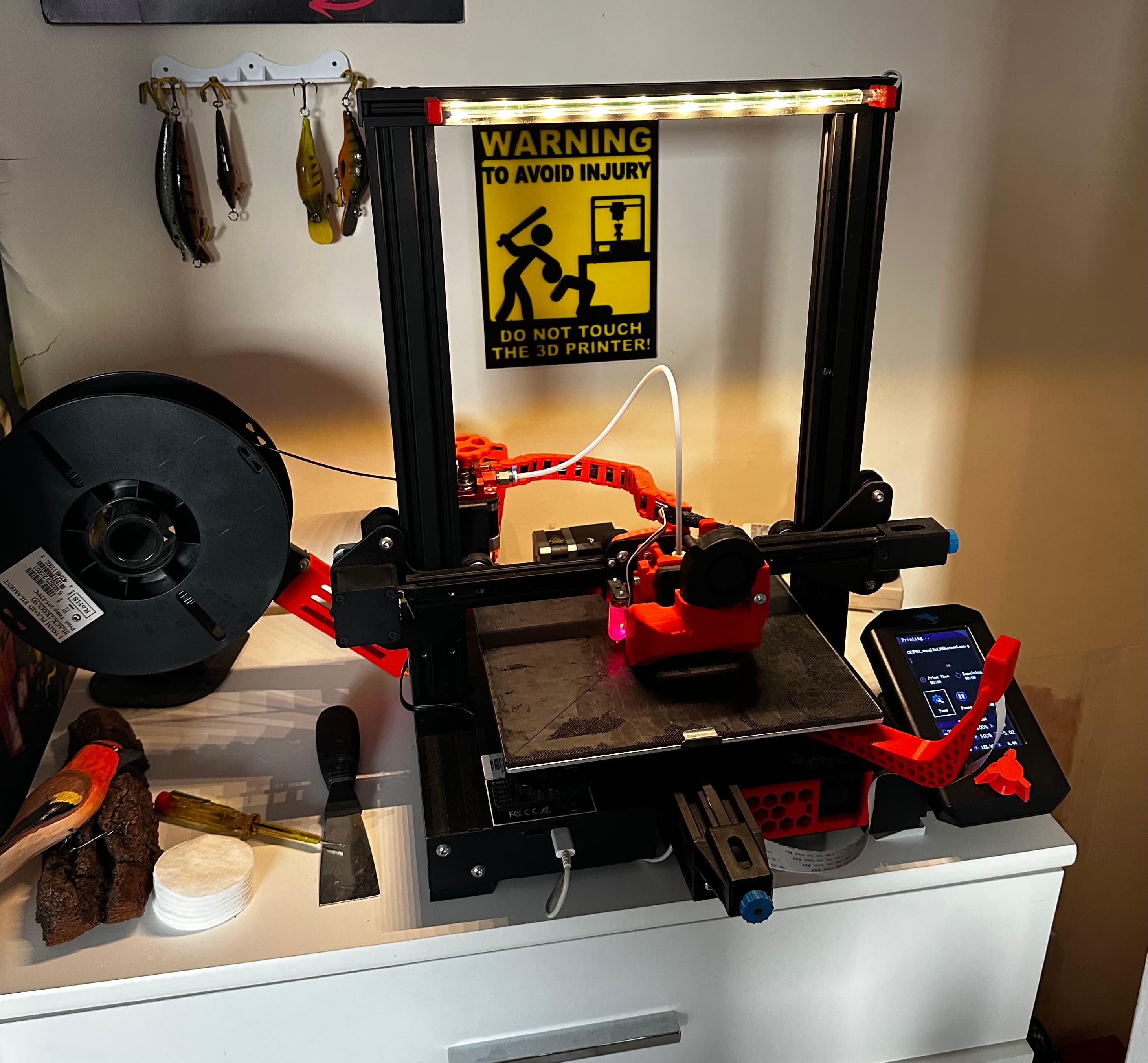
A consumer Ender 3 rebuilt subsystem by subsystem — custom firmware, auto bed levelling, remote monitoring, and an extruder housing printed on the printer it was for.
The Problem
A stock Ender 3 V2 is fine until you ask it for something specific. The bed has to be levelled by hand before anything important and still gives an inconsistent first layer; the stock extruder is a known mechanical weak point that shows up on exactly the long prints you can least afford to lose; and the machine tells you nothing until you walk back into the room and find eight hours of filament spaghetti. Three different subsystems, and fixing one keeps exposing the next.
The Approach
Took each limitation as its own subsystem — identify what's actually failing, research the fix, fit it, then iterate until it holds. The upgrades chain into each other, which is the interesting part: fitting a BLTouch probe for automatic bed levelling meant the stock firmware no longer described the machine, so the next step was compiling Marlin from source with probe support and the motion settings the new hardware needed. Reliability meant replacing the extruder and designing a custom housing around it with upgraded hotend and part cooling — printed on the machine being upgraded. Monitoring meant a Raspberry Pi 3B+ running OctoPrint over USB with a camera module, so a print can be started, watched and killed from anywhere.
The Outcome
Started at 15 and still running, with the printer as its own test bed. Bed meshing replaced manual levelling entirely, which is what made the first layer repeatable rather than a thing to be nursed. Extrusion held across multiple materials and long durations once the extruder and cooling were sorted. The firmware compile was the point it stopped being a consumer appliance — once you're editing configuration files to match hardware you changed yourself, nothing about the machine is a black box any more.